State of Hunger 2026
In Maine, people are finding ways to care for their families and make each dollar stretch as the cost of everyday essentials continues to rise. For some, that means carefully planning meals, relying on seasonal income, sharing resources, or turning to community food programs when the household budget falls short.
Across the state, higher costs for food, housing, health care, transportation, and other necessities are putting added pressure on families, children, older adults, and working Mainers. At the same time, local food pantries and meal programs are seeing more people seek support.
Today, more than 203,000 Mainers experience food insecurity, representing 14.5% of the state’s population, up from 13.8%. More than 50,600 Maine children experience food insecurity, meaning 20.7% of Maine children face hunger, the highest rate in New England.
These numbers tell us the need is growing, but they do not tell the whole story. Food insecurity can affect people who are working, raising families, caring for loved ones, and contributing to their communities. It can happen when seasonal work slows, an unexpected expense arises, or a paycheck simply cannot keep pace with the cost of living.
For many Mainers, a local food pantry provides more than groceries. It offers a way to stretch limited resources, maintain access to nutritious food, and create a little more breathing room when times are difficult. Most of all, it reflects the strength of communities coming together to make sure their neighbors have what they need.
A Growing Need Across Maine
The need for food assistance has been growing at the same time that some of the resources available to meet that need have declined.
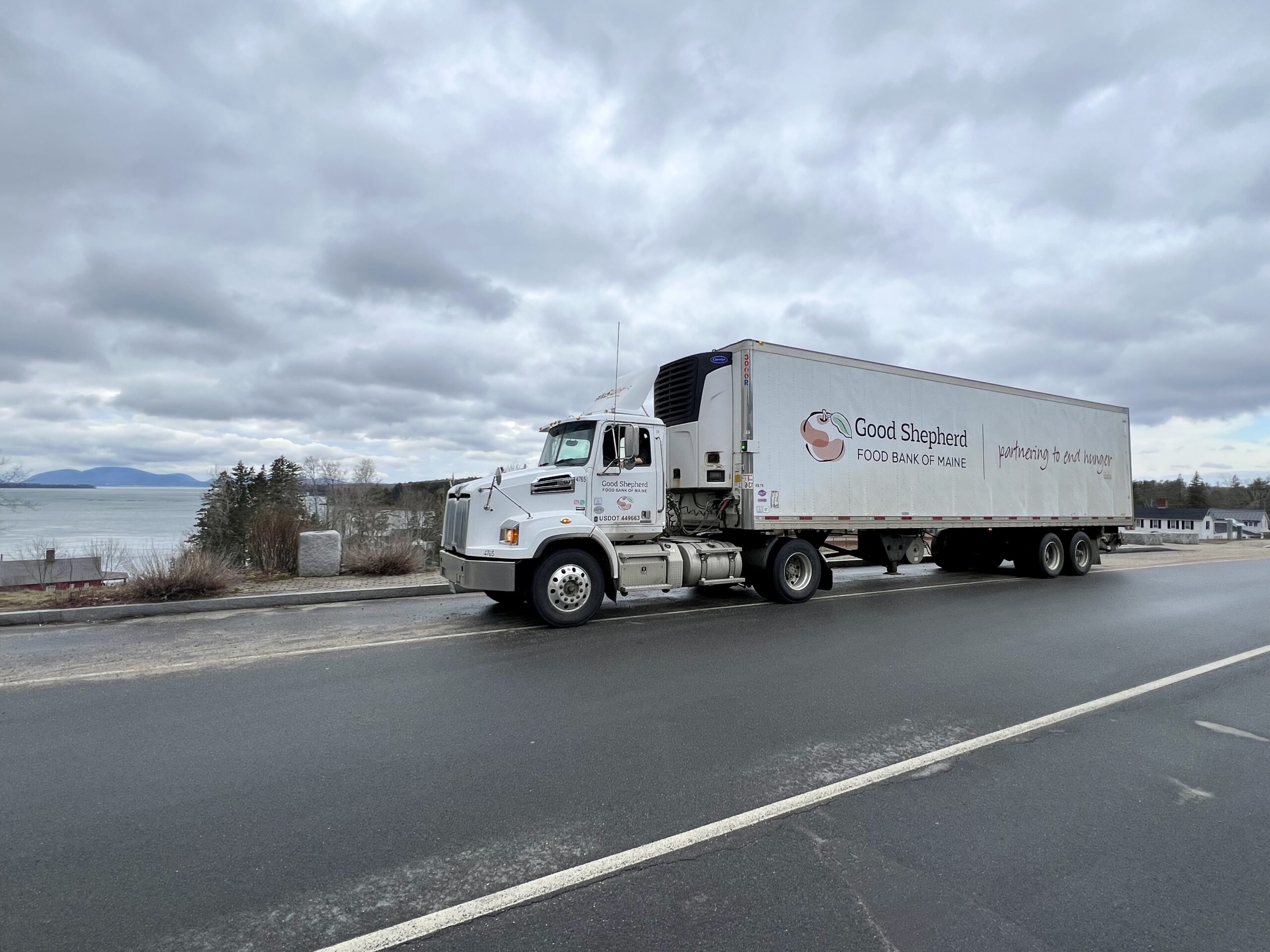
Federal reductions have affected the amount of food available for distribution throughout Maine. Over the past year, Good Shepherd Food Bank has seen a reduction of 4.5 million pounds of federally funded food, along with declines in other nutrition resources.
That means local food pantries and meal programs are being asked to do more with less, just as more people are walking through their doors.
Changes to federal nutrition programs, including the Supplemental Nutrition Assistance Program (SNAP), are also affecting Maine families. Since eligibility changes went into effect last October, more than 15,000 Mainers, including more than 4,000 children, have lost SNAP benefits.
Pantry partners across the state are seeing the consequences firsthand. Some are reporting levels of need approaching those seen during last October’s federal government shutdown, when demand surged across Maine, indicating that the reality may be even greater than the data suggest.
For people experiencing food insecurity, asking for help isn’t always the first choice. Many stretch meals, skip meals, buy less nutritious food, or simply go without before they seek assistance. By the time someone walks through the doors of a food pantry, they may already have been making difficult choices for months.
When Food Assistance Becomes a Lifeline
For Good Shepherd Food Bank and its community partners, responding to this growing need means finding ways to fill the gaps when other resources fall short.
Thanks to our generous donors, Good Shepherd Food Bank invested $5.3 million directly in food and funds for Maine communities last year. Those investments included additional purchases of local produce, food purchasing credits, and financial grants for community partners.
The impact of those investments can be measured in food distributed and shelves stocked. But the deeper impact can be understood by listening to the people who walk through pantry doors.
Their stories remind us that hunger is rarely just about food.
Food Insecurity can take many forms and can be shaped by circumstances that are often outside a person’s control. It may come during a season when work slows, after an unexpected medical diagnosis, when a family grows, or when the cost of essentials like groceries and fuel rises faster than a paycheck. Sometimes, even careful planning and hard work are not enough to make everything fit, and a little support can help ensure there is enough food to get through the week.
Meet Robert: Making a Seasonal Living Stretch Through Winter
For Robert, making a living in Maine has always been tied closely to the rhythms of the coast. A Mainer whose family has lived in the state for generations, Robert works as a lobsterman in northern Maine. His work is deeply seasonal and dependent on factors beyond his control, including weather, natural resources, and the realities of the fishing industry.
During the busy season, he works and saves as much as he can. But when winter arrives, stretching those dollars can become difficult. Even after carefully budgeting what he earned during the season, Robert found himself struggling to keep up with household bills and the rising cost of groceries. Gasoline costs more. Food costs more. And when income slows down, every dollar has to go further. That’s where the local food cupboard comes in.
Robert has visited several times, shopping with a volunteer and leaving with a bag of groceries that helps carry him through the week. “I love this place,” he says. For Robert, the cupboard isn’t a substitute for working. It is what helps make working through a difficult season possible. “This really helps tide me over through the wintertime,” he explains.
The help means that the bills can continue to get paid without forcing him to choose between keeping up with those expenses and having enough to eat. “[Coming here means that] the bills can keep getting paid and I can still eat.” And the difference is particularly meaningful when it comes to nutritious food.
Without the cupboard, Robert says, “with gas prices and how expensive groceries are, I wouldn’t have as many fruits and vegetables.”
Robert’s story reflects the determination and resourcefulness of many Mainers who work hard, contribute to their communities, and find ways to navigate the changing realities of making a living in Maine.
For those whose work is seasonal, having access to community food resources can provide important stability during the months when income is less predictable. That support gives Robert and others like him more flexibility to manage rising expenses, continue providing for their families, and make nutritious food part of the household budget.
Meet Danny: One Income, One Family, and a Place to Belong
For Danny, the road to the food cupboard began after he and his wife moved to Maine. The couple has two daughters, ages 17 and 19. Danny works as an educational technician at a school serving children with autism and other special needs. His wife is unable to work because she is disabled and lives with lupus. Her disability income is limited, leaving Danny as the family’s primary wage earner.
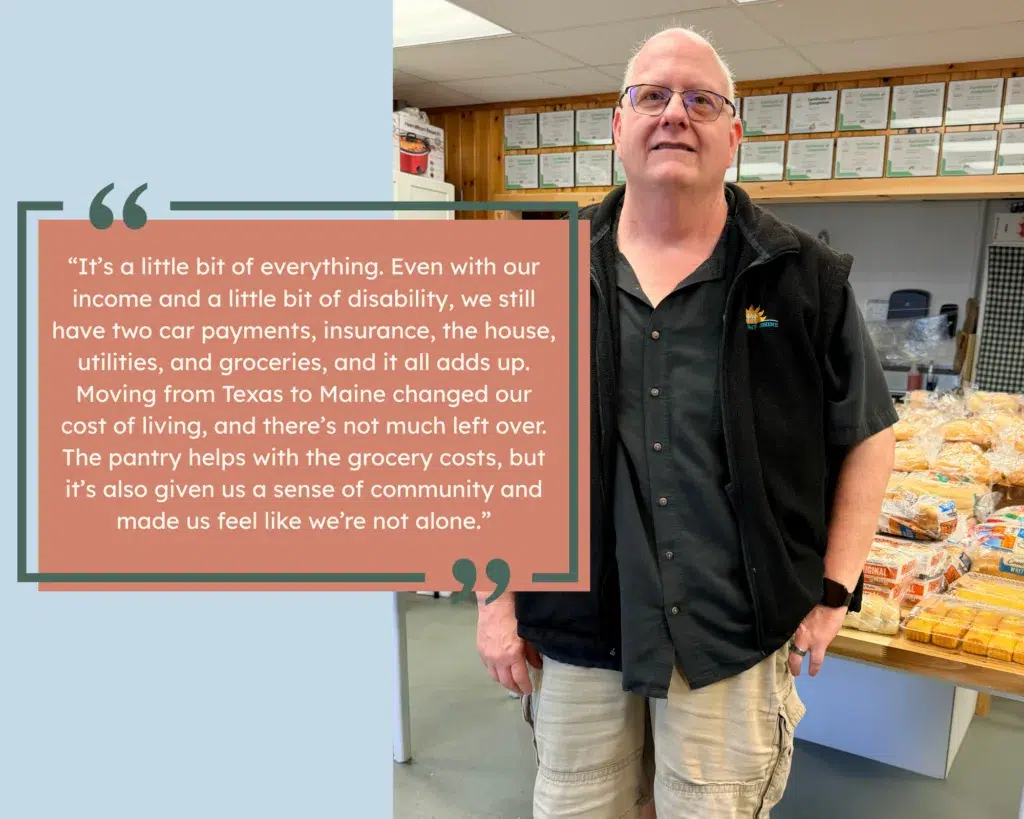
With one income supporting the household, the family’s expenses add up quickly. Housing, utilities, insurance, car payments, gas, and groceries all compete for the same dollars. After everything is paid, there isn’t always much left.
Danny discovered the cupboard online after the family moved to Maine. They live nearby, and what began as a search for local resources became a source of steady support. He has been coming for nearly two years and visits almost every week. Without the cupboard and places like it, Danny says, things would be “really tough.”
The food helps the family stretch their grocery budget, including staples like meat and potatoes, as well as foods his daughters enjoy. But what Danny has found at the cupboard goes beyond the groceries he brings home.
Moving to a new state can be an exciting new beginning, but it can also take time to find a sense of community, especially when you’re coming from somewhere else. For Danny and his family, the cupboard became one of the places where those connections began to grow.
He has gotten to know the volunteers and other people who come regularly. They talk about sports and football, and the volunteers know he’s a Pittsburgh Steelers fan. They also know him by his accent, which earned him the nickname “Texas.”
Those familiar conversations have helped turn a place he initially found by searching online into somewhere he feels known and welcomed. Over time, the cupboard has become a place where Danny can not only find food for his family, but also connect with people and feel part of the community.
Danny and his family moved to Maine because they were looking for a healthier environment for his wife and because they had family connections in the state. They have come to love Maine, its weather, and especially its people.
For Danny, the cupboard represents something he says is central to the community he has found here: people helping one another. The support is “really needed,” particularly as the cost of groceries and gasoline continues to rise, but the sense of connection has become meaningful in its own way.
Meet Angela: Hunger Is About More Than an Empty Plate
For Angela, food insecurity is something she sees not only in her own household but throughout her community.
Angela is an early intervention preschool teacher. She and her partner have a 10-year-old daughter, and their household also includes other members of their community whom they support as they learn to navigate adulthood. Altogether, there are seven people in the home.
With that many people sharing one household, the grocery budget can disappear quickly.
Angela has been coming to the food cupboard consistently for nearly three years. Everyone contributes to the household bills, but food remains one of the areas where the family needs additional help. The cupboard helps them make it through the weeks when the budget gets tight.
Her daughter loves tomatoes, fruits and vegetables, pasta, tacos, and different kinds of meat. The family also has several dietary considerations to manage, making the challenge of providing nutritious and appropriate food even more complicated.
Without the cupboard, Angela says, the family would have to stretch much further. She would have to buy less expensive varieties of meat. Fresh fruits and vegetables would be harder to afford. Variety would disappear. And with seven people in the house, variety matters. But Angela’s understanding of hunger goes beyond what is in a grocery bag.
“Food-based need looks like having the same fruit thing for lunch every day,” she explains. “It looks like giving up meals.”
It can mean sending a child to school with a lunchbox that contains only the bare necessities. It can mean choosing who gets a full portion. It can mean deciding whether there is enough money for food or another urgent expense.
“It looks like sacrifice,” Angela says. And those sacrifices don’t stop with food.
Hunger is connected to health, work, and family life. It can mean going to work while sick because you can’t afford to stay home. It can mean sending a child to school when they’re not feeling well because you can’t miss work. It can mean living with a constant series of compromises.
For Angela, that is why places like the food cupboard matter so much. The cupboard doesn’t just provide food. It provides dignity. “It doesn’t judge. It doesn’t gatekeep. It allows people to come in and just be people.” That sense of dignity is powerful.
A food pantry can be a place where someone receives something they couldn’t otherwise afford, including fresh produce, meat, a dessert for their children, or an ingredient that makes a meal feel a little more normal.
It can also be a place where neighbors discover other resources and connect with people who can help. For Angela, that community connection is one of the cupboard’s greatest strengths.
![A person in pink overalls and a purple shirt stands by a shopping cart, smiling. Quote: [The Food Cupboard] doesnt judge. It doesnt gatekeep. It allows people to come in and just be people..](https://www.gsfb.org/wp-content/uploads/2026/09/Blog-Landscape-Photos-2026-09-16T134043.305-1024x819.webp)
Robert, Danny, and Angela each arrived at a food cupboard for different reasons. Their circumstances are different. Their families are different. Their paths to Maine are different.
But they share something important: they found a community willing to help.
That is what food security looks like at its best: a bag of groceries that helps stretch a household budget, fresh produce on the table, a family sharing a meal, or a volunteer who remembers your name. It is the reassurance of knowing that when times are difficult, there is a community ready to stand alongside you. Together, these small acts of support create something much bigger: a stronger, more connected food security network where every Mainer can access the food they need and know they are not facing difficult times alone.
Together, we can build a stronger, more resilient food security network, one where every Mainer has access to the food they need and no one in Maine faces hunger alone.